---
title: "The Behavioural Sink: War, Sustainability, and Loneliness in the AI Era"
description: "On fifth-generation warfare, the Ceuta border crisis of 2026, and Universe 25: three views of what collapses first when a society has everything but trust."
author: "Mael Emilyah Gaulinus"
published: 2026-08-16T13:00:00.000Z
language: en
canonical: https://dakukitsune.ca/thoughts/the-behavioural-sink/
ai_assisted: true
tags: ["reflection", "society", "technology", "loneliness", "war"]
---
# The Behavioural Sink: War, Sustainability, and Loneliness in the AI Era
On fifth-generation warfare, the Ceuta border crisis of 2026, and Universe 25: three views of what collapses first when a society has everything but trust.
> "Insanity in individuals is something rare — but in groups, parties, nations, and epochs it is the rule."
>
> Friedrich Nietzsche, [_Beyond Good and Evil_](https://www.gutenberg.org/ebooks/4363), 156
The question reached me in French, in a post I have now read several times. _Sommes-nous dans une guerre de cinquième génération?_ Are we living through a fifth-generation war? The author describes a conflict with no front, no soldiers in ranks, no flag raised over ruins: feeds instead of artillery, perceptions instead of territory, and a victory condition that needs no treaty. I did not dismiss it, and I did not accept it either.
What I can do is point at three things and ask whether they rhyme. A definition with a scholarly pedigree. A border in the summer of 2026, where a rumour moved tens of thousands of bodies. And a mouse utopia from the 1960s that had everything a body needs and collapsed anyway. Between them runs the tension I want to examine: a war over perception, abundance that forgot what must also be sustained, and loneliness as the ground both of them feed on.
## The War That Takes No Territory
The phrase is not a podcast invention. Waseem Ahmad Qureshi, writing in the [San Diego International Law Journal](https://digital.sandiego.edu/ilj/vol21/iss1/7/), traces the generations of warfare from massed conscripts to insurgency to what Daniel H. Abbott calls fifth-generation warfare: a war of perceptions, carried out through information rather than force, aimed at what a population believes rather than what it holds. The weapon is not the shell. It is the frame.
The post that started this puts it in one line. Translated from the French; the translation is ours: "It is a war in which what is destroyed is no longer infrastructure, but trust." And, further down: "It does not need you to see it in order to win. It only needs you to no longer know what is true."
Nietzsche wrote his version in 1886, a century before the first feed. [Aphorism 156](https://www.gutenberg.org/ebooks/4363) of _Beyond Good and Evil_ says insanity is rare in individuals and standard in groups, parties, nations, and epochs. He was not prophesying the internet. He was describing the medium any perception war travels through: a crowd that has agreed to feel before it thinks. A weapon aimed at belief needs no new ammunition. It only needs the oldest one.
Let me be careful about what I am not saying. I cannot prove that a fifth-generation war is underway, and I distrust anyone who says they can. Wars have authors and commands. What I am looking at has owners and incentives, and those are not the same thing. So I take the concept as a lens, not a verdict, and I ask what its signature would look like. Events coordinated by belief rather than by orders. Masses moved by messages rather than mobilized by states. If that signature exists anywhere in the summer's news, it exists at Ceuta.
## What Actually Happened at Ceuta
First, the precedent. In May 2021, about eight thousand people, including some fifteen hundred minors, walked and swam into the Spanish enclave of Ceuta from Morocco in two days, after a diplomatic quarrel over Spain's sheltering of the Polisario Front leader Brahim Ghali led Moroccan border guards to step aside. Most were returned within days. [BBC News](https://www.bbc.com/news/articles/cx2kp639yx4o) covered the aftermath; the [border incident](https://en.wikipedia.org/wiki/2021_Morocco%E2%80%93Spain_border_incident) is now a standard reference in every argument about borders and leverage.
Then, this summer. Over a few days in late July 2026, roughly [72,000 people](https://www.aljazeera.com/news/2026/8/12/morocco-says-working-to-prevent-potential-new-ceuta-crossings-surge) crossed into Ceuta, most of them young men, many swimming around the breakwaters to the beach at Tarajal. Spain deployed the army and [agreed urgent returns](https://www.euronews.com/my-europe/2026/07/30/spain-and-morocco-agree-urgent-return-of-latest-ceuta-migrants) with Morocco. The vast majority went back within days; when I write this, about two thousand remain, and around a thousand of those are unaccompanied children. Let me be careful with the dead. Spain counted at least eighty. The Moroccan Association for Human Rights counted at least 141. Morocco recovered eleven bodies on its own side. The sea does not file reports, so the honest sentence is that at least eighty people died, and probably well over a hundred. Spain has since strung a [barrier across the water](https://www.lemonde.fr/en/international/article/2026/08/02/spain-installs-sea-barrier-on-ceuta-s-border-with-morocco-after-frontier-rush-that-killed-67_6756077_4.html) at the border.
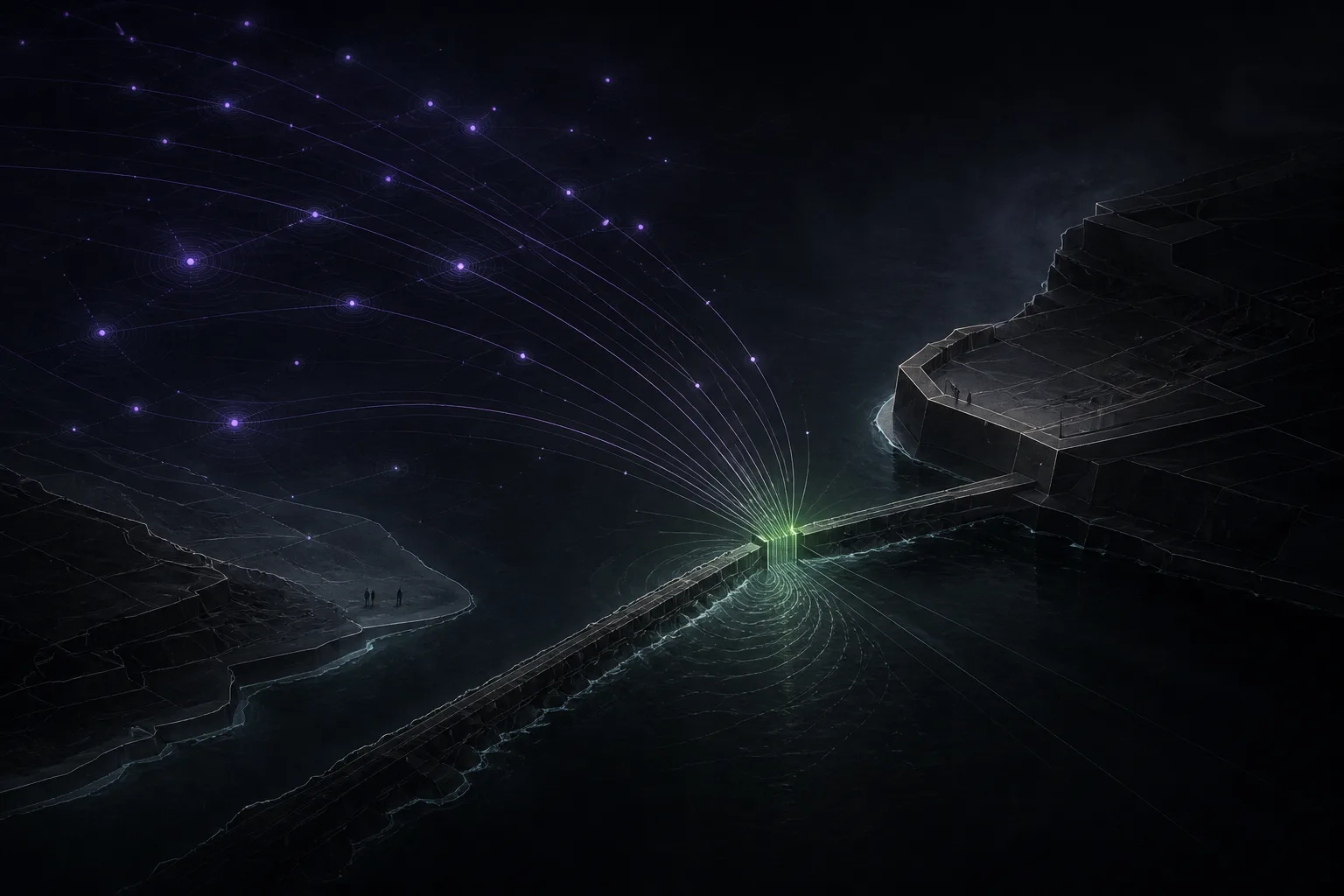
Now the part that belongs to this essay. The surge was not ordered by an army. It was organized by a rumour: messages on Facebook and WhatsApp, misrepresenting a June ruling by Spain's Supreme Court about returns at sea, telling people the door would be open. Spain's Interior Ministry said trafficking networks were exploiting the ruling. A second mass crossing was called for August 15, a Spanish holiday, in posts that Moroccan authorities said they would prosecute. On the fifteenth, the border held.
None of that fits the vocabulary of invasion, which is exactly the word being used. I want to hold two things at once here. The people in the water were real people with real reasons, many of them children with no one. And the word chosen to describe them, _invasion_, is itself a move on the same board: the moment you accept it without asking who benefits from it, perception has already done its work. Both things are true. That is what makes this era hard to look at.
Here is my reading, and it is mine. Whether or not any hand steered the surge, Ceuta demonstrated what coordination by belief can do to a European border in forty-eight hours. That is the military fact of the summer, and it will be studied somewhere, by someone, regardless of what we call it.
A rumour can move through a network before anyone has established whether it is true.
## The Universe That Had Everything
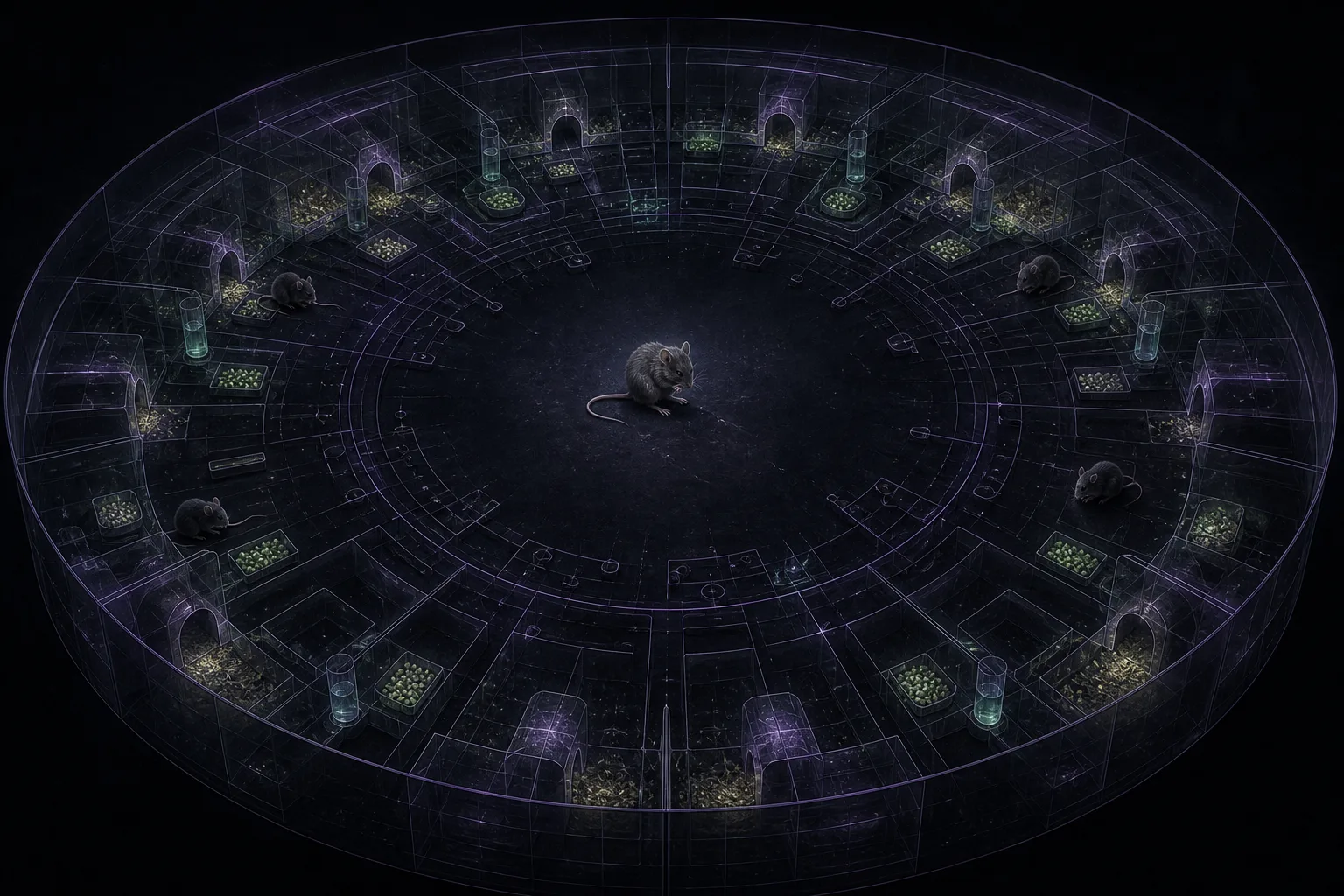
In 1968, at the National Institute of Mental Health, the ethologist John B. Calhoun built the twenty-fifth of his rodent universes. He described a mortality-inhibiting environment: unlimited food, unlimited water, nesting boxes, no predators. Space was the only limit, and there was room for thousands. The population peaked near 2,200 mice. Then it began to fall, and it never stopped falling. Calhoun recorded the whole arc in ["Death Squared"](https://pmc.ncbi.nlm.nih.gov/articles/PMC1644264/), and the pattern he had earlier named the [behavioural sink](https://en.wikipedia.org/wiki/Behavioral_sink) appeared in its final form.
The decline was social before it was numerical. Mice withdrew from each other or fought without purpose. Females abandoned litters. Births fell toward zero, and the young that were born mostly did not survive. A class of males emerged that ate, slept, and groomed, sleek and unmarked, wanting nothing to do with anyone. Calhoun's readers named them the beautiful ones. By 1973 the universe was empty. The food had not run out. The water had not run out. What ran out was the social world, and then the mice.
I need to say what this does not show. Snopes is right to warn against the doom reading, and I want to be careful. Rodents are not people. Follow-up work by psychologists such as Jonathan Freedman found that density itself was not the poison; what hurt was unrelieved, meaningless interaction, and humans manage crowding differently. Calhoun himself did not offer his universe as a prophecy. He spoke of a kind of spiritual death, and he spent the rest of his career looking for designs that would avoid it.
So I take Universe 25 as a question, not a forecast. What happens to a social creature when every material need is met and every social role collapses? Every sustainability programme I have read means material sustainability: carbon, water, budgets. Universe 25 was materially sustainable to the very end. The collapse was in trust, then in meaning, then in mice. Extending that to our cities is my interpretation, not Calhoun's conclusion, and I want it marked as such. But I notice that no ministry anywhere has a portfolio for the renewal of trust, and I wonder what plan would.
Material abundance does not answer the question of how a social world is sustained.
## The Beautiful Ones
Loneliness needs no laboratory. The U.S. Surgeon General's 2023 [advisory](https://www.hhs.gov/sites/default/files/surgeon-general-social-connection-advisory.pdf) reported that about half of American adults had experienced loneliness, put the mortality impact of disconnection on par with smoking fifteen cigarettes a day, and linked poor social relationships to a 29 percent higher risk of heart disease and a 32 percent higher risk of stroke. Those are bodies. This is not a mood.
I have written before about [how loneliness narrows a life](https://dakukitsune.ca/thoughts/the-open-door-and-the-duty-to-care/) until one door looks like the only one. The beautiful ones stay with me as an image, not a diagnosis. Withdrawal is quiet, and it wears the costume of self-care. The coat is immaculate. The world goes unmated. Ask yourself which of your habits is grooming and which is tending.
## The Machine That Sits Between Us
What is new in our era is not group madness, and it is not loneliness, and it is not stupidity, which Frank Zappa nominated, in [The Real Frank Zappa Book](https://quoteinvestigator.com/2014/01/09/hydrogen/), as the basic building block of the universe in place of hydrogen. Quote Investigator notes he was polishing an older joke, and that Harlan Ellison told versions of it too; jokes outlive their authors precisely because they keep being true.
What is new is the machine in the middle. Systems that learn what holds attention and sell that knowledge. Synthetic crowds that manufacture the appearance of agreement. Companions for rent that never leave and never know you. I believe, and I cannot prove, that the distinguishing weapon of this era is not any one of these but their combination: madness, loneliness, and stupidity, each industrialized and priced per impression. That sentence is an interpretation. The parts it is made of are documented above.
Jung wrote, in ["The Aims of Psychotherapy"](https://www.jstor.org/stable/j.ctt5hhr69): "It all depends on how we look at things, and not on how things are in themselves." If the war of our era is a war of perceptions, then the contested ground is exactly the place he points to: the angle from which a fact is seen. A feed is a machine for choosing that angle for you. The algorithm does not need to lie. It only needs to decide, a thousand times a day, what you look at first, what you never see, and who appears to agree.
## What Is Still in My Control
Perception war, if that is what this is, wins by exhaustion. Too tired to check. Too divided to trust. Too alone to hold a line. Its counter is unglamorous and local, and it is the only defence I trust.
Verify one claim before passing it on, especially the one that flatters you. Eat with someone weekly, in person, at a table. Say "I don't know" out loud, in company, where it can be corrected. Keep one chair where people who disagree still eat together. Be harder to frighten and easier to find.
The mice lost their social world and retreated into their fur, and the food was right there the whole time. We still get to choose what we look at, and Jung was right about what that is worth. Whatever name this era earns, the ground it fights over is the oldest one: what you believe, and who can still correct you. Hold that ground in person.
_La perception commence ici._
## Sources
- [Post on fifth-generation warfare (in French)](https://x.com/AlainPatenaude7/status/2084615191342268434)
- [Beyond Good and Evil, aphorism 156](https://www.gutenberg.org/ebooks/4363)
- [The Practice of Psychotherapy (Collected Works, Vol. 16), "The Aims of Psychotherapy"](https://www.jstor.org/stable/j.ctt5hhr69)
- [Quote Investigator on "more stupidity than hydrogen" (documents the line in The Real Frank Zappa Book)](https://quoteinvestigator.com/2014/01/09/hydrogen/)
- [Death Squared: The Explosive Growth and Demise of a Mouse Population](https://pmc.ncbi.nlm.nih.gov/articles/PMC1644264/)
- [Universe 25 'Rodent Utopia' Experiment Doesn't Mean What You May Have Heard](https://www.snopes.com/articles/466960/john-calhoun-universe-25/)
- [Behavioral sink](https://en.wikipedia.org/wiki/Behavioral_sink)
- [Fourth- and Fifth-Generation Warfare: Technology and Perceptions](https://digital.sandiego.edu/ilj/vol21/iss1/7/)
- [Morocco says working to prevent potential new Ceuta crossings surge](https://www.aljazeera.com/news/2026/8/12/morocco-says-working-to-prevent-potential-new-ceuta-crossings-surge)
- [Spain and Morocco agree urgent return of latest Ceuta migrants](https://www.euronews.com/my-europe/2026/07/30/spain-and-morocco-agree-urgent-return-of-latest-ceuta-migrants)
- [Spain installs sea barrier on Ceuta's border with Morocco](https://www.lemonde.fr/en/international/article/2026/08/02/spain-installs-sea-barrier-on-ceuta-s-border-with-morocco-after-frontier-rush-that-killed-67_6756077_4.html)
- [Ceuta crisis: Spain's PM blames traffickers as thousands cross from Morocco](https://www.bbc.com/news/articles/cx2kp639yx4o)
- [2021 Morocco–Spain border incident](https://en.wikipedia.org/wiki/2021_Morocco%E2%80%93Spain_border_incident)
- [Our Epidemic of Loneliness and Isolation: The U.S. Surgeon General's Advisory](https://www.hhs.gov/sites/default/files/surgeon-general-social-connection-advisory.pdf)
> AI may have contributed to the draft. Mael Emilyah Gaulinus reviewed, verified, and approved the final piece.